Seasonal grape harvest jobs in Portugal: Douro, Alentejo and Vinho Verde
Portugal’s grape harvest, the vindima, offers seasonal jobs cutting and carrying grapes on wine estates and cooperatives, mainly in the Douro, Alentejo and Minho, for a few weeks between mid-August and mid-October, usually under a fixed-term contract.
This page in other languages : Français · Português
What does grape harvest work in Portugal involve?
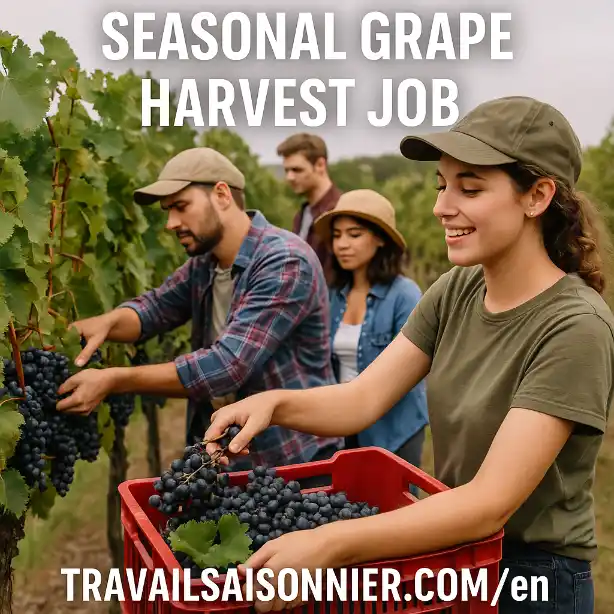
Much of Portugal’s grape crop is still picked by hand, so the vindima creates thousands of short contracts every year. Pickers cut bunches with secateurs, fill plastic crates, carry them to tractors or trailers and sometimes help sort grapes at the winery.
Conditions vary sharply between regions. The steep schist terraces of the Douro Valley, a UNESCO World Heritage landscape, make the work physically demanding, while the flatter vineyards of the Alentejo allow a steadier pace and are increasingly combined with mechanical harvesting.
Which wine regions hire seasonal pickers?
The Douro, around Peso da Régua, Pinhão and São João da Pesqueira, is the best known because of port wine. The Alentejo near Évora, Reguengos and Vidigueira, the Vinho Verde area of Minho, the Dão, Bairrada and Lisbon regions also hire.
Harvest calendar by region
In the Alentejo and Tejo, white varieties are often picked from mid-August. The Douro usually harvests from late August to early October, while Minho and Dão concentrate on September. A single contract typically lasts between two and six weeks.
A typical day on a quinta
Work starts early, around 7 a.m., to avoid afternoon heat that often exceeds 30°C. Full crates weigh about 20 kilos, and in the Douro they must be carried along narrow paths between dry-stone walls, so good footwear and stamina matter.
Who can work the harvest in Portugal?
Citizens of the European Union, the European Economic Area and Switzerland enjoy free movement and need no visa or work permit. A valid ID card or passport is enough, followed by the Portuguese tax and social security numbers required by every employer.
EU citizens staying longer than three months must request a registration certificate from the local council. For a harvest lasting a few weeks this step is usually unnecessary, but the NIF tax number and NISS social security number remain essential.
Seasonal work visas for non-EU nationals
Third-country nationals must obtain a seasonal work visa from a Portuguese consulate before travelling. Under Law 102/2017, a short-stay visa covers up to 90 days, and a temporary stay visa covers longer contracts of up to nine months within twelve.
Documents required for the visa
Applicants need a signed seasonal contract paying at least the minimum wage, proof of accommodation, travel insurance, a recent criminal record certificate and proof of means. The contract must start at least fifteen days after the application is submitted.
Age limits and the role of AIMA
The legal minimum working age is sixteen, with extra protections for minors. Since October 2023 AIMA has replaced SEF for residence matters, while consulates and the foreign ministry’s e-Visa portal process visa applications, sometimes through VFS Global centres.
Pay and working conditions for grape pickers
Since 1 January 2026 the Portuguese mainland minimum wage is €920 gross per month, up from €870 in 2025. Harvest workers are usually paid a daily rate, which must at least match the minimum wage calculated on a pro rata basis.
Normal working time is eight hours a day and forty hours a week. Overtime carries a premium, and seasonal employees are entitled to proportional paid leave plus pro rata holiday and Christmas allowances under the Portuguese Labour Code.
Which contract applies to harvest work?
Employers may use a fixed-term contract justified by seasonal activity, or a very short-term contract allowed in agriculture for up to 35 days, with a maximum of 70 days a year with the same employer. Both must be reported to social security.
Accommodation and meals during the season
Some Douro estates still house crews in traditional dormitories and provide meals. Elsewhere, pickers often have to find their own room, which is difficult in wine villages during September. Any accommodation deduction must be agreed in writing beforehand.
Social security and tax deductions
Employees contribute 11% of gross pay to Segurança Social, and employers pay their own share on top. Income tax may be withheld depending on tax residence, so keep every payslip in case you later need to claim a refund.
How to land a grape harvest contract
Most hiring takes place between June and August, before picking starts. Large port houses and cooperatives rely on local crew leaders, temporary work agencies or the public employment service, while smaller quintas often recruit through word of mouth.
- Prepare a short CV in English or Portuguese stressing stamina and farm experience.
- Check IEFP and EURES job offers from June onwards.
- Contact quintas, cooperatives and adegas in your target region directly.
- Confirm the daily rate, hours, accommodation and expected dates in writing.
- Non-EU applicants should file the seasonal visa application with the signed contract.
- On arrival, obtain your NIF and NISS before your first working day.
- Pack gloves, ankle boots, a hat and long-sleeved clothing.
Typical costs and documents
Joining the harvest involves some upfront costs, especially when accommodation is not included. The table below summarises the main figures and paperwork to prepare before you start work on a Portuguese wine estate.
| Item | Typical amount or detail |
|---|---|
| Minimum wage 2026 | €920 gross per month, paid in 14 instalments a year |
| Employee social security | 11% of gross pay |
| National visa fee (non-EU) | Around €110, non-refundable |
| Proof of means | €920 per month of stay for the temporary stay visa |
| Mandatory numbers | NIF (tax) and NISS (social security) |
| Personal kit | Gloves, secateurs, walking shoes, sun protection |
Common mistakes and scams to avoid
The harvest attracts unscrupulous middlemen every year, often advertising on social media. Labour inspections have uncovered undeclared work and overcrowded housing in Portuguese agriculture. A few simple precautions considerably reduce the risk of a bad experience.
- Paying recruitment or visa fees to an intermediary, which is unlawful and often a scam.
- Starting work without a written contract or social security registration.
- Accepting shared housing without knowing its cost and conditions.
- Handing your passport to an employer or crew leader.
- Arriving in the Douro in September without booked accommodation.
How to spot a genuine offer
A reliable offer names the company, its tax number, the estate’s address and a precise wage. Be wary of personal email addresses, promises of unusually high earnings and any request for money before you are hired.
Grape harvest in Portugal: frequently asked questions
The answers below cover the questions most often raised by international applicants planning a first harvest season in Portugal, whether they come from elsewhere in Europe, from Portuguese-speaking countries or from other non-EU states.
Do I need to speak Portuguese to pick grapes?
No, instructions are simple and crews are often international. A few Portuguese words still help with safety, integration and communication with the crew leader. Spanish speakers usually follow conversations in the vineyard without much difficulty.
Can I work in several wine regions in one season?
Yes, by following the staggered calendar: the Alentejo in August, then the Douro or Dão in September. Each employer needs a separate contract, and visa holders must make sure dates and employers match their visa conditions.
Do wine estates provide accommodation?
Sometimes, especially large isolated estates in the Douro, but it is not guaranteed. When housing is provided, its conditions and any charge should appear in the contract. Otherwise, book a room several months ahead, as September demand is high.
How much can a grape picker earn in a season?
Based on the €920 monthly minimum, a full month earns at least that gross amount, plus proportional leave and holiday allowances. Actual pay depends on the employer, overtime and any productivity bonus agreed before the harvest starts.
Where to find these jobs
- IEFP – Job offers search (iefponline) — Portugal's public employment service search engine: thousands of vacancies filterable by region, occupation, contract type and openness to non-residents.
- Agroportal – Agricultural job offers — Portuguese farming portal posting weekly vacancies and internships at farms, wineries and cooperatives, including harvest-season internships.
- EURES – European job search — Official EU job mobility portal listing vacancies from public employment services, filterable by country, region and occupation.
- IEFP – Vacancies for non-EU non-residents — IEFP page grouping job offers open to third-country nationals living outside Portugal, with direct applications and visa guidance.
- EURES – Foreign Workers in Portugal — EURES project hosted by Portugal’s labour inspectorate explaining seasonal workers’ rights, contracts and pay, with guides in several languages.
Official and legal references
- 2026 minimum wage (Decreto-Lei 139/2025) — Summary of the decree setting Portugal’s guaranteed monthly minimum wage at €920 on the mainland from 1 January 2026.
- Seasonal work temporary stay visa (E8) — Official checklist for the Portuguese seasonal work visa over 90 days: contract terms, financial means, accommodation and insurance.