

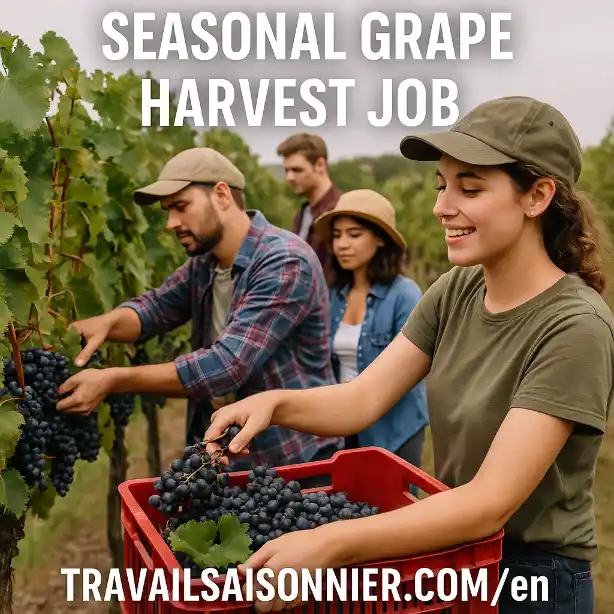
GRAPE HARVEST WORK 2026
A seasonal grape harvest job inrefers to short-term work carried out during the grape harvesting period in vineyards, where teams of workers are hired specifically for a limited number of weeks. The two dimensions are inseparable: the work is seasonal, linked to a precise agricultural calendar, and it is directly focused on the grape harvest, in the fields, in the cellar or in logistics. It is not just “a seasonal job” or “a vineyard job” taken separately, but a combination of both: an intense, time-bound activity dedicated to picking, handling and processing grapes..
Functioning and objectives of a seasonal grape harvest job
How does a seasonal grape harvest job work ?
In many wine regions, a seasonal grape harvest job takes place once a year, often at the end of summer or in early autumn, depending on the climate and the ripeness of the grapes. Employers recruit additional staff to reinforce their permanent teams: students, job seekers, local workers and sometimes foreign seasonal workers. The job exists only because of the harvest window; outside this period, the same tasks either do not exist or are carried out on a much smaller scale by the resident staff of the vineyard or winery.
How a seasonal grape harvest job is organised
In practice, the functioning of a seasonal grape harvest job is based on daily work schedules focused on the rhythm of the vineyard and the weather. Workers meet early in the morning at the farm, at a meeting point or at the accommodation if it is included. The day is then split between hand picking the grapes, transporting crates, sorting bunches in the vineyard or at the cellar, and cleaning or preparing equipment. Breaks and meals are organised collectively and adapted to the pace of the harvest and the temperature.
The organisation of a seasonal grape harvest job may vary: some positions are 100% field work, bent over the vines; others are more focused on sorting tables, operating small machinery, driving tractors or trucks, or helping with cellar operations such as pressing and pumping. Some employers offer positions with accommodation and meals on site, while others recruit only local workers who commute every day. The contract is usually clearly bounded in time: from a few days to several weeks, depending on the size of the vineyard and the harvest conditions.
Objectives of a seasonal grape harvest job for workers and employers
For the worker, the main objective of a seasonal grape harvest job is to earn income over a short period, sometimes to complement another job, a period of study or a job search. It also offers the opportunity to discover the world of wine, to work outdoors, to experience strong team spirit and to develop physical endurance and practical skills. For many people, it is a first contact with the labour market, a chance to learn about punctuality, safety rules and cooperation in a concrete production context.
For employers, the objective of a seasonal grape harvest job is to secure enough reliable labour to bring in the entire harvest within a short time frame, without compromising quality or safety. A well-organised harvest team allows the grapes to be picked at the right moment, sorted carefully and brought quickly to the cellar, which has a direct impact on the quality of the future wine. Seasonal jobs also help maintain the economic and social fabric of rural areas by creating recurring opportunities for local and seasonal workers.
Skills, working conditions and career role of seasonal grape harvest jobs
A seasonal grape harvest job requires good physical condition, the ability to work in a bent or standing position for several hours, and the capacity to carry loads such as buckets, crates or hoses. It also demands respect for instructions, awareness of safety rules (tools, tractors, steep plots), and the ability to cooperate in small teams under the supervision of a foreman or vineyard manager. No formal diploma is strictly necessary for most picking positions, but experience in manual or outdoor work is an advantage, and some specialised roles (tractor driving, cellar operations) may require specific licences or prior training.
Working conditions in a seasonal grape harvest job are shaped by the climate, the terrain and the employer’s organisation: early starts, variable weather, sometimes mud or heat, repetitive gestures and intense days of work. In return, many vineyards offer a strong sense of camaraderie, shared meals, and sometimes accommodation on site or nearby. On a broader career path, a seasonal grape harvest job can be a gateway to more stable positions in viticulture, cellar work, wine tourism or agricultural management, especially for people who repeat the experience over several years or combine it with training in agriculture or oenology.
A responsible approach to a seasonal grape harvest job
A responsible approach to a seasonal grape harvest job means checking contracts, working hours, pay and accommodation conditions before accepting, and making sure that safety rules and basic rights are respected. It also involves being transparent about one’s availability, health constraints and level of experience, so that the employer can assign appropriate tasks. When the job offers accommodation, it is important to understand the rules of community life, the cost (if any) and the quality of facilities.
For employers and recruitment platforms, being responsible means publishing clear job descriptions, indicating whether accommodation is included, specifying the expected duration in weeks and the physical demands of the job, and ensuring fair working conditions. The comparison tool below lists different types of organisations and platforms offering seasonal grape harvest jobs, including job boards, temporary employment agencies and direct vineyard employers, to help candidates identify offers that match their profile and expectations.
• Major job boards with dedicated sections for vineyard and harvest jobs.
• Temporary employment agencies that place teams directly with wine estates and cooperatives.
• Direct recruitment by vineyards and wine groups, often with on-site accommodation during the harvest weeks.
Seasonal jobs by season
Compare seasonal work opportunities for summer, winter, fall, beach work, ski jobs and harvest periods.