Fruit picking jobs: harvest seasons, earnings and how to get hired
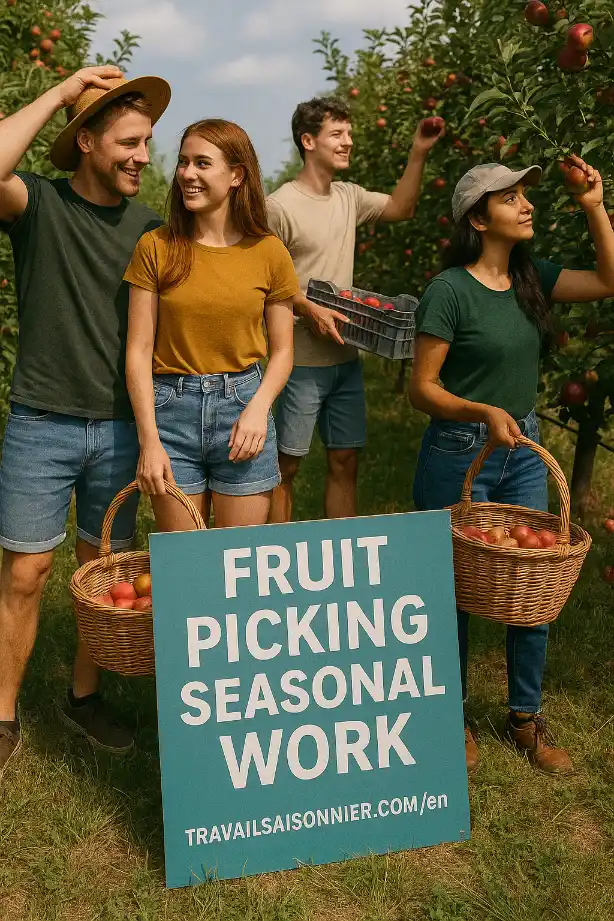
A fruit picking job is short seasonal farm work harvesting berries, cherries, stone fruit, apples or kiwifruit by hand, usually for a few weeks to a few months, paid by the hour or by the bin and tied to each crop’s ripening dates.
This page in other languages : Français
What a fruit picker does day to day
Pickers harvest ripe fruit to size and colour guidelines, fill buckets, trays or bins and carry them to the row end. The work is done bending low, on ladders or from mobile platforms, often starting at dawn to avoid the heat.
Many farms combine picking with related work such as thinning, netting, field grading or shifts in the packhouse. Supervisors check quality and speed, and the best pickers are often offered longer contracts, better rows or team leader roles the following season.
Picking calendar in the main destinations
Dates shift each year with the weather: a warm spring can bring strawberries forward by two weeks, while hail or frost can cut a season short. Farms usually confirm start dates only a few weeks ahead, so flexibility is a real advantage.
| Country | Main crops | Peak months |
|---|---|---|
| France | Strawberries, cherries, apricots, apples | April to November |
| Spain | Strawberries and berries in Huelva, citrus | February to June, citrus in winter |
| United Kingdom | Strawberries, raspberries, apples | May to October |
| Australia | Cherries, berries, mangoes, apples | November to April, varies by state |
| New Zealand | Cherries, apples, kiwifruit | December to May |
| Canada | Berries, cherries, apples | June to October |
Best crops for first-timers
Apples and kiwifruit suit beginners: the technique is quick to learn, seasons last several weeks and farms hire in large numbers. Strawberries are harder on the back, while cherries involve ladders. Blueberries reward careful hands, because damaged fruit is rejected at grading.
Where the jobs cluster
In Australia, the Goulburn Valley, Sunraysia, Bundaberg and Tasmania offer long seasons. In New Zealand, Hawke’s Bay, Bay of Plenty, Nelson and Central Otago lead. In Europe, the Rhône Valley, Huelva, Kent and the Dutch and Belgian fruit belts are the main hubs.
Who is allowed to pick fruit abroad?
EU, EEA and Swiss citizens can pick fruit anywhere in that area without a permit, and they receive the same minimum pay and social security as local workers. They only need an ID card, a local tax or insurance number and a written contract.
Since 2021, EU citizens need a visa for the United Kingdom like everyone else. The Seasonal Worker visa allows up to six months of horticulture work with a licensed sponsor, for an application fee of 340 pounds, and must be arranged before travelling.
Working Holiday visas for pickers
Australia and New Zealand welcome young travellers on Working Holiday visas, generally for ages 18 to 30 and up to 35 for nationalities such as French, Irish and Canadian. In Australia, 88 days of specified work in eligible regional areas unlock a second visa year.
Visa holders must show health insurance and savings on arrival. Canada’s International Experience Canada programme offers similar permits, while the United States relies on the employer-sponsored H-2A visa, so independent travellers cannot simply turn up and pick fruit there.
Employer-sponsored seasonal schemes
Pacific and Timor-Leste workers come to Australia through the PALM scheme and to New Zealand through the Recognised Seasonal Employer scheme. Germany, Spain and Italy run quotas for selected partner countries. These routes are always initiated by the employer, never by paying an agent.
Sponsored workers usually receive a contract before departure, with travel, housing and minimum hours set out in advance. Anyone offered such a place in exchange for a fee, or asked to pay for a job letter, should treat the offer as a scam.
How much fruit pickers earn
Pay is either hourly or by piece. New Zealand’s adult minimum wage is 23.95 dollars per hour from 1 April 2026, and France’s Smic is 12.31 euros gross per hour since 1 June 2026. Piece rates cannot legally fall below these floors in either country.
In Australia, horticulture workers paid by piece have been guaranteed a minimum hourly rate since 2022. Fast pickers on good crops earn well above the minimum, but rain days, poor yields and accommodation fees can make weekly income uneven.
Deductions must be agreed in writing and shown on payslips. Accommodation, transport or equipment charges taken from wages are regulated in Australia, New Zealand and the EU, and a deduction that pushes pay below the minimum is generally unlawful.
Typical costs and pay items
The table below summarises the figures to check before accepting an offer. Costs vary widely between a free farm cabin in rural New Zealand and a shared hostel room in a busy Australian harvest town during the peak cherry season.
| Item | What to expect |
|---|---|
| Hourly minimum | 23.95 NZD (NZ, 2026), 12.31 EUR gross (France, June 2026) |
| Piece rate | Per bin, bucket or kilo, topped up to the minimum |
| Accommodation | Free to about 150 to 250 per week in hostels or farm cabins |
| Transport to the farm | Own car often needed, shuttles sometimes deducted |
| Work gear | 40 to 120 for boots, gloves, rain jacket and hat |
How to land a fruit picking job
- Choose the crop and region using the local harvest calendar.
- Confirm your right to work: EU citizenship, a Working Holiday visa or a sponsored permit.
- Search official boards such as PickNZ, Work and Income or Australian state harvest pages.
- Contact orchards and licensed labour-hire firms directly a few weeks before the season.
- Get the hourly rate, piece rate, hours and accommodation cost in writing.
- Book accommodation early and arrange transport between the hostel and the farm.
- Track your hours daily and compare them with each payslip.
Mistakes and scams pickers should avoid
- Paying a fee to secure a farm job or a visa sign-off.
- Working cash-in-hand, which may not count towards visa extensions.
- Accepting piece rates with no hourly minimum guarantee.
- Using an unlicensed labour-hire contractor or handing over your passport.
- Paying a hostel bond for a job that does not exist.
Fruit picking FAQ
These answers address the questions most often raised by first-time pickers, from backpackers on Working Holiday visas to European students looking for a summer job and seasonal workers chaining several harvests across different regions and countries.
Do I need experience to pick fruit?
No. Farms train newcomers on the first morning, and speed builds within a week or two. Experience helps you get hired at peak times and earn more on piece rates, but most seasons depend heavily on first-time pickers and travellers.
Can I count picking days for a second Australian visa?
Yes, if the farm is in an eligible postcode and you are paid correctly under Australian law. Keep payslips and records of every day worked, because cash work or underpaid days may be rejected when applying for the second-year visa.
What happens when it rains?
Picking usually stops in heavy rain, and hourly workers are generally paid only for time worked. Some farms switch staff to packhouse shifts. Budget for lost days, especially in spring and autumn when weather is less predictable.
How long does a picking season last?
Cherry seasons can be over in four to six weeks, while apple and kiwifruit seasons often run two to three months. Experienced pickers follow the harvest from region to region and can work most of the year by chaining crops.
Where to find these jobs
- PickNZ – Seasonal job board — New Zealand job board for orchard and vegetable seasonal work, filtered by region and crop, with job alerts.
- Agriculture Victoria – How to get a harvest job — Victorian government guide to finding harvest work in Australia, checking labour-hire licences and recording your hours.
- Work and Income – Finding seasonal work — New Zealand public service guide to seasonal work by type, region and month, from orchards and vineyards to ski fields.
Official and legal references
- Seasonal Worker visa – GOV.UK — UK visa for horticulture work of up to six months or poultry work in late autumn, with a licensed sponsor and a 340-pound fee.
- New Zealand minimum wage 2026 – Employment New Zealand — Adult minimum wage of 23.95 New Zealand dollars per hour from 1 April 2026, before tax.
- French minimum wage (Smic) 2026 – Service-Public.gouv.fr — Official French minimum wage: 12.31 euros gross per hour and 1,867.02 euros gross per month for a 35-hour week.