Seasonal jobs in Germany: harvests, tourism, minimum wage and permits
Germany hires tens of thousands of seasonal workers each year for asparagus, strawberries, hops, the grape harvest, Alpine and coastal tourism and Christmas markets, with a statutory minimum wage of 13.90 euros per hour in 2026.
This page in other languages : Français · Deutsch · Español
What seasonal work does Germany offer?
German Saisonarbeit is concentrated in agriculture and horticulture, which rely heavily on foreign labour, and in hotels and restaurants in tourist areas. Retail, logistics and Christmas markets add short but numerous hiring peaks at the end of the year.
Most farm jobs are physical and repetitive, paid by the hour or by output, often with shared accommodation on the farm. Tourism roles more often require some German or English, but offer contracts of several months in resorts or on the coast.
Main harvest regions
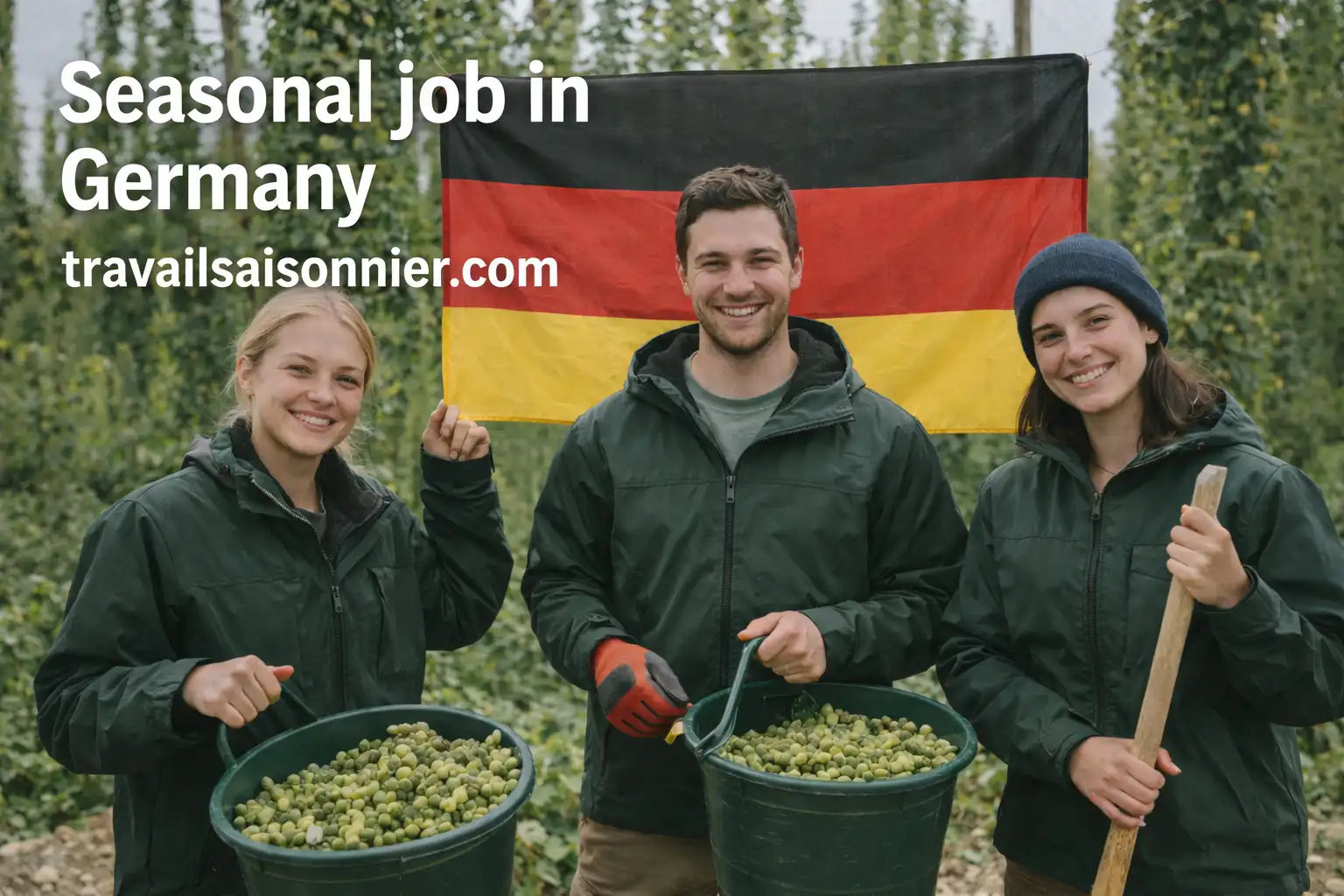
Asparagus is harvested mainly in Lower Saxony, in Brandenburg around Beelitz, in North Rhine-Westphalia and in Baden-Württemberg. Strawberries follow in the same areas. Hops are picked in the Hallertau in Bavaria, the largest hop-growing region in the world.
The grape harvest employs pickers along the Moselle, in the Palatinate, Rheinhessen, Baden and Franconia. Apples are picked in the Altes Land near Hamburg and around Lake Constance, while field vegetables keep crews busy across the northern plain.
- Agriculture: asparagus, strawberries, cherries, hops, apples, grapes, vegetables.
- Tourism: hotels and restaurants in the Bavarian Alps, North Sea and Baltic coast.
- Events: beer festivals, music festivals and summer fairs.
- Year-end retail: Christmas markets, warehouses and parcel delivery.
Germany’s seasonal calendar
The farming calendar starts early in spring and ends in autumn, after which winter tourism and Christmas markets take over. Asparagus farms often start recruiting in January for a season that opens in April.
| Activity | Working period | Main regions |
|---|---|---|
| Asparagus | April to late June | Lower Saxony, Brandenburg, Baden |
| Strawberries | May to July | Lower Saxony, Rhineland, Baden |
| Hops | Late August to September | Hallertau, Tettnang |
| Grape harvest | September to October | Moselle, Palatinate, Baden |
| Apples | August to October | Altes Land, Lake Constance |
| Christmas markets | Late November to December | Nuremberg, Cologne, Dresden, Munich |
Summer and winter tourism
In summer, the islands of Sylt and Rügen, the Baltic coast and the Bavarian lakes hire service and kitchen staff from May to September. In winter, Garmisch-Partenkirchen, Oberstdorf and Berchtesgaden recruit from December to March for hotels and ski lifts.
Who can work a season in Germany?
As elsewhere in the European Union, nationality determines the paperwork. Europeans arrive freely, while everyone else must use a specific placement scheme or hold a residence title that explicitly allows employment.
EU, EEA and Swiss citizens
Europeans need neither a visa nor a work permit. They must register their address with the town hall if they stay for longer periods, and give the employer an ID document, a tax number and, if they remain insured at home, an A1 certificate.
Non-EU nationals: placement agreements
The Federal Employment Agency places seasonal farm workers from Georgia and Moldova under placement agreements. Employment is limited to 90 days in any 180-day period, with at least 30 hours a week, and the permit is issued without involving visa offices.
Other routes exist, such as the Western Balkans regulation or working holiday visas for young people from partner countries, but they follow separate procedures. Without a suitable title, no third-country national may work legally in Germany.
Students and short-term jobs
European students often use short-term employment, the kurzfristige Beschäftigung, which is exempt from social contributions if it lasts no more than three months or 70 working days per calendar year. In agriculture the limit rises to fifteen weeks or 90 days.
Pay, hours and conditions
German labour law applies to everyone employed in the country, whatever their nationality. The written contract must specify the workplace, duration, hourly or piece rate, working hours, paid leave and start date.
Minimum wage in 2026
The statutory minimum wage is 13.90 euros gross per hour since 1 January 2026 and will rise to 14.60 euros on 1 January 2027. Piece-rate pay can never push the real hourly earnings below this floor.
Housing and deductions
For seasonal workers placed by the Federal Employment Agency, the employer must provide or arrange suitable accommodation. Rent may be deducted from pay only if the contract says so and within social security limits, leaving the worker the protected minimum.
Minijobs and social contributions
A minijob is capped at 603 euros per month in 2026. Above that, or if a short-term job exceeds the time limits, health, pension, care and unemployment contributions become due. Seasonal workers without cover need health insurance, otherwise provided by the employer.
Steps to secure a season in Germany
German farms tend to rehire the same crews every year, so applying early and doing a good first season is the best way to be invited back.
- Pick the crop or resort you are targeting and check its hiring window.
- Write a short CV in German or English, with exact availability and farm experience.
- Search vacancies through EURES and contact a EURES adviser in your home country.
- Email asparagus farms, strawberry growers or wine estates directly from January.
- Obtain a written contract stating hourly pay, hours, housing and deductions.
- Prepare ID, European Health Insurance Card or A1 form and a bank account.
- On arrival, register your address if required and keep your own record of hours.
Common traps and scams
Customs inspections have repeatedly uncovered abuse in harvest work. The following points deserve particular attention before and during the season, especially for first-time workers.
- Paying an intermediary for a place: placement by the Federal Employment Agency is free.
- Accepting piece rates without a guarantee of the 13.90 euro hourly minimum.
- Signing a German contract without understanding the housing and meal deductions.
- Working without a personal log of hours, essential in any dispute.
- Staying uninsured during a short-term job exempt from contributions.
Costs and documents
The table below summarises the reference amounts and documents useful for a season in Germany. Deductions vary between farms and must appear clearly in the contract and on the payslip.
| Item | 2026 benchmark | Note |
|---|---|---|
| Minimum wage | 13.90 euros gross per hour | 14.60 euros from 1 January 2027 |
| Minijob ceiling | 603 euros per month | Contributions due above it |
| Short-term employment | 3 months or 70 days | 15 weeks or 90 days in farming |
| Accommodation | Often provided and deducted | Amount stated in contract |
| Documents | ID, tax number, IBAN | A1 or health insurance |
Language and daily life
A few words of German make daily life much easier, but many farms manage international crews in English, Polish or Romanian. In tourism, conversational German is often required for any customer-facing role in hotels and restaurants.
Frequently asked questions
These answers address the situations most commonly faced by international candidates considering a first harvest or tourism season in Germany.
How much does an asparagus picker earn?
At least 13.90 euros gross per hour in 2026, even when paid by the kilo. Output bonuses come on top of the legal minimum. Net pay depends on housing deductions and on contributions if the job is not short-term employment.
Do I need to speak German for harvest work?
Usually not in the fields. Instructions are often given in English or in the crew’s language. Understanding the contract remains essential, and the Federal Employment Agency requires it to be understandable to both parties, bilingual if necessary.
Can a Moroccan or Indian national pick fruit in Germany?
Not through the current placement agreements, which cover Georgia and Moldova. Another residence title allowing work, issued by a German embassy under the available skilled or employment immigration routes, would be needed, which is rare for picking.
Can I combine several short jobs in one year?
Yes, but the three-month or 70-day limits apply to all short-term jobs in the calendar year combined. Once exceeded, social contributions become mandatory. Each employer must report the short-term job to the Minijob-Zentrale.
Detailed seasonal jobs
Where to find these jobs
- EURES Germany – Seasonal work page — EURES network: information for EU and non-EU seasonal workers on permits, wages, insurance and contracts in Germany.
- Federal Employment Agency – Seasonal farm work leaflet — Official 2026 leaflet on placing seasonal farm workers: pay, housing, contract and application procedure.
- EURES – Services for jobseekers — European job portal: seasonal vacancies, EURES advisers in every country and online recruitment fairs.
Official and legal references
- TK – Minimum wage and minijobs 2026 — Techniker Krankenkasse: 2026 and 2027 minimum wage, minijob ceiling and rules for foreign employees.
- Minijob-Zentrale – Short-term employment — Official minijob agency: three-month and 70-day limits, plus specific rules for agriculture.
- Federal Employment Agency – Third-country seasonal workers — Placement agreements with Georgia and Moldova, maximum duration and conditions for seasonal farm work.