Grape harvest jobs in Germany: regions, timing and pay
In Germany, seasonal grape harvest work means cutting and sorting grapes by hand from September to October in one of thirteen wine regions such as the Mosel, the Pfalz or Rheinhessen, for at least the statutory minimum wage.
This page in other languages : Deutsch · Français
Grape picking in Germany: what is the Weinlese?
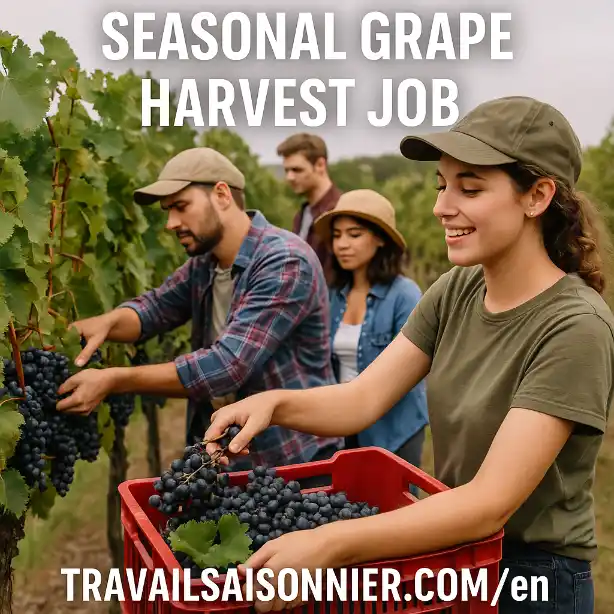
Grape pickers cut bunches with secateurs, remove damaged berries and empty their buckets into a back basket or crate. Basket carriers then haul the harvest up to the tractor. Careful hand sorting is essential for Germany’s quality wine categories and premium labels.
On the slopes of the Mosel or the Rheingau, often steeper than 30 percent, machine harvesting is impossible and seasonal labour remains vital. In flatter wine areas machines dominate, but wineries still hire extra hands for sorting, cellar work and packing.
Which wine regions hire?
Germany has thirteen wine regions. Rheinhessen and the Pfalz are the largest, followed by Baden, Württemberg and the Mosel. Franken, Nahe, Rheingau, Ahr, Mittelrhein, Saale-Unstrut, Sachsen and Hessische Bergstrasse complete the map of seasonal grape picking jobs.
When does the harvest take place?
Picking starts in late August or early September with early varieties for sparkling wine, then peaks in September and October with Riesling and Pinot Noir. Late-harvest wines and ice wine can stretch the season into December in good years.
A short, intense season
A harvest lasts three to eight weeks depending on the size of the estate. The pace follows ripeness and weather: winemakers often decide the evening before, and on rainy days picking stops, which reduces the number of paid hours that week.
Who can work the grape harvest in Germany?
EU, EEA and Swiss citizens can pick grapes freely, without any visa. Many family estates also welcome students, retirees and regulars who return every autumn. Health insurance and a valid identity document are still required before the first day.
Options for third-country nationals
The Federal Employment Agency scheme for Georgian and Moldovan seasonal workers explicitly covers viticulture. It allows 90 working days in any 180-day period, with at least 30 hours a week, on the basis of an application filed by the employing estate.
Nationals of the Western Balkans can use the Western Balkans regulation, with a work visa and prior approval by the Federal Employment Agency. The annual quota of 50,000 is often used up before autumn, making it a poor fit for a short harvest.
Working Holiday visa holders, open among others to young Canadians, Australians, New Zealanders and Japanese, usually aged 18 to 30, are a common source of labour in the vineyards of the Mosel and the Pfalz.
Short-term employment and the 90-day limit
Grape pickers are generally registered in contribution-free short-term employment. On farms and estates the annual limit is now 15 weeks or 90 working days. Days already worked during the asparagus or strawberry harvest in the same year are added together.
Insurance and flat-rate tax
The employer may apply a flat 25 percent wage tax or the standard tax based on the worker’s tax class. With no social contributions paid, health cover must be proven by a European Health Insurance Card, a home insurer certificate or private insurance.
Pay and conditions for grape pickers
The statutory minimum wage is 13.90 euros gross per hour in 2026 and rises to 14.60 euros in 2027. It applies to every grape picker working in Germany, whatever their nationality, and even when pay is calculated per crate.
Estates usually pay by the hour. Basket carriers, whose work is more physically demanding, sometimes receive a supplement. Shared lunches in the vineyard are part of the tradition and are frequently provided free of charge, without any deduction from wages.
Staying with the winemaker
Estates often provide accommodation in guest rooms, dormitories or holiday flats. Any deduction must be agreed in writing and stay below the official 2026 values: 285 euros a month for accommodation and 345 euros a month for full board.
Working days and safety
The normal working day is 8 hours, extendable to 10 if the average is balanced out. On steep slopes, hiking boots, gloves and protection against secateur cuts are strongly recommended; workplace accidents are covered by the employer’s statutory accident insurance.
What a harvest costs and pays
The table below gathers the main amounts and documents for a grape harvest season in Germany. Legal values are for 2026; travel and personal equipment are usually paid by the worker unless the estate agrees otherwise in writing.
| Item | Amount or document | Comment |
|---|---|---|
| Minimum wage | €13.90/h gross (2026) | €14.60 in 2027 |
| Gross pay over 4 weeks | About €2,200 at 40 h/week | Before deductions and tax |
| Housing deduction | Up to €285/month | Official 2026 value |
| Full board deduction | Up to €345/month | Lunch often free |
| Flat-rate tax | 25% possible | Or standard tax by tax class |
| Equipment | Boots, gloves, rain gear | Secateurs often provided |
Finding a wine estate in 7 steps
Estates finalise their crews between June and August. A structured approach helps you secure a contract in the region you want and avoid arriving without work or a bed just as the grapes reach full ripeness.
- Choose one or two wine regions and check their usual harvest dates.
- Search the Federal Employment Agency job board, EURES and farm job boards from spring onwards.
- Write directly to family estates, in German if possible, giving your availability.
- Non-EU nationals: check whether the ZAV scheme or a Working Holiday visa applies and let the employer apply.
- Get hourly pay, housing, meals, deductions and estimated duration confirmed in writing.
- Prepare health insurance, an identity document, an IBAN and rain gear.
- Stay reachable until the last moment, as the start date can shift with ripeness.
Common mistakes and scams
The harvest also attracts misleading offers, especially on social media. The following situations come up regularly with advice services for foreign workers and during minimum wage inspections carried out by the German customs authorities.
- Paying a processing fee to a middleman who promises a place on an estate.
- Accepting a daily flat rate below the minimum wage times the hours actually worked.
- Travelling without written confirmation of the start date and accommodation.
- Forgetting to add up the days already worked in agriculture that year.
- Neglecting footwear and clothing suited to steep slopes and rain.
Do you need German to pick grapes?
It is not compulsory, but some German helps you fit in on small family estates, where communication is mostly in the local language. On larger estates, team leaders often speak English, Polish or Romanian and translate the daily instructions.
Can accommodation be free?
Some family estates offer free board and lodging to keep loyal crews. Others deduct a contribution within the legal limits. Always get the exact amount in writing, because it has a strong impact on the net income you take home from the season.
Is the grape harvest suitable for beginners?
Yes. Cutting bunches can be learned in a morning. Beginners usually start as pickers, while basket carrier and cellar helper roles go to more experienced or physically very robust workers who can handle heavy loads on steep terrain.
Can you work several vineyards in a row?
Yes. Dates vary between regions, from earlier Baden to later Saxony. Working at two estates is possible, but each employer needs to know the days already worked so that the annual short-term employment limit is respected.
Where to find these jobs
- BayernPortal – Work permit for seasonal farm workers — Public service description: conditions, forms, processing times of about four to eight weeks and the free procedure for non-EU seasonal farm workers.
- Federal Employment Agency – Named request form — Official form allowing a German farm to request a Georgian or Moldovan seasonal worker it already knows by name before the work permit is issued.
- JobJump – German job board — German job search engine listing seasonal, harvest, cook and waiter vacancies, with free job alerts and collective-agreement pay tables.
- Make it in Germany – Advice for Western Balkans applicants — Federal government portal: local advisory services, job listings, visa guidance and language preparation for applicants from the Western Balkans region.
Official and legal references
- Techniker Krankenkasse – Minimum wage 2026 — Statutory health insurer explaining the minimum wage of 13.90 euros since January 2026, 14.60 euros from 2027 and the 603-euro minijob ceiling.
- Techniker Krankenkasse – Seasonal farm work 2026 — Explains the extension of contribution-free short-term employment on farms to 15 weeks or 90 working days per calendar year.
- Federal Employment Agency – Seasonal farm work fact sheet — Official sheet: minimum wage even on piece rates, compliant housing, health insurance, bilingual contract and the ZAV procedure for seasonal farm workers.