Bulgaria: seasonal fruit and vegetable picking jobs in roses, berries, orchards and vineyards
In Bulgaria, seasonal fruit and vegetable picking jobs follow a harvest year that opens with strawberries and roses in spring and closes with grapes and apples in autumn. Work is physical, often begins at dawn and takes place in fields, orchards and greenhouses across the Thracian Plain, the Kazanlak Valley and the south-west. Pay may be hourly, daily or by weight, depending on the farm. A written contract, safe transport and clear housing terms are the key points a picker should settle before starting, whatever the crop.
Crops and regions
Bulgaria has a varied farming landscape. The Rose Valley between the Balkan and Sredna Gora ranges, centred on Kazanlak and Karlovo, is known for oil-bearing roses and lavender. The Thracian Plain around Plovdiv, Pazardzhik and Stara Zagora produces tomatoes, peppers, cucumbers and fruit, while the Danube plain supports sunflower, cereals and vegetables. Kyustendil in the west has a reputation for cherries, apples and plums.
The south-west, around Petrich, Sandanski and Melnik, enjoys a warmer climate suited to early vegetables, fig trees, vineyards and tobacco. Raspberries and blueberries grow in the cooler Rila foothills near Samokov. Vineyard regions include the Struma Valley, the Thracian lowlands and the Black Sea hinterland, with grape picking tied to the cellar calendar of each estate.
| Month | Crop or task | Main area |
|---|---|---|
| May | Strawberries, rose blossom picking | Kazanlak Valley, Plovdiv region |
| June and July | Cherries, lavender, raspberries | Kyustendil, Karlovo, Rila foothills |
| July to September | Tomatoes, peppers, melons, plums | Thracian Plain, Pazardzhik, Haskovo |
| September to October | Grapes, apples, walnuts, tobacco leaf | Melnik, Struma Valley, Danube plain |
The Kazanlak rose harvest has a ceremonial dimension. Each year in early June the town holds the Rose Festival, with a parade and a rose queen, and pickers in traditional costume appear in tourist events. For workers the experience means very early mornings, careful hand picking into cloth sacks and a faint scent that clings to clothes. Distilleries and cosmetics firms purchase the blossoms the same day to protect quality.
Tasks, pace and hardship
Rose picking is a signature task. Blossoms must be gathered at first light, before the heat reduces their oil, so workers are in the fields around five in the morning and finish by late morning. The scent is pleasant, but the work is repetitive and the thorns are real. Lavender cutting and herb gathering follow a similar early rhythm, with the crop taken quickly to distillation.
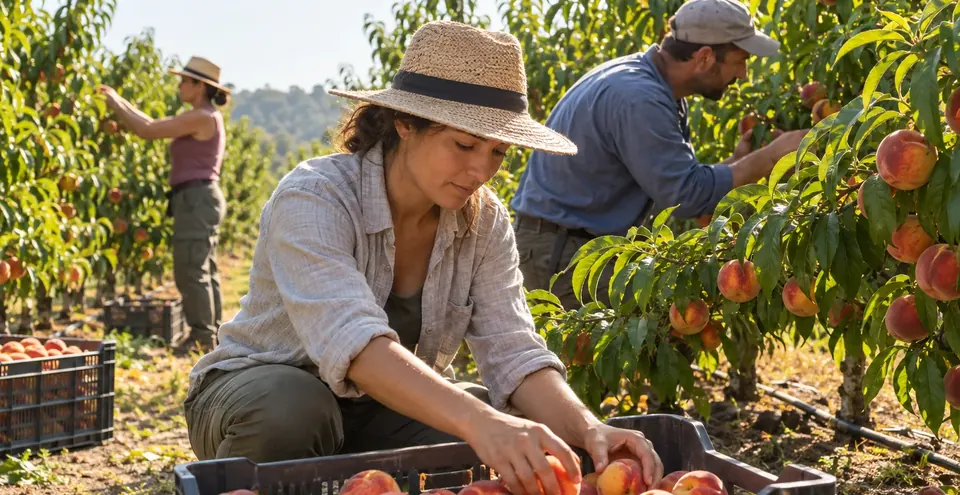
Orchard picking involves ladders, sacks and crates. Cherry and plum harvests are time sensitive, and pickers handle fruit gently to avoid bruising. Vegetables in greenhouses mean heat, humidity and long bending positions. Grape harvest brings sticky hands, wasps and heavy buckets. The work is demanding but suited to people used to outdoor labour who can keep a steady pace.
Rest breaks, water and shade should be provided in line with labour rules. In July and August, afternoon heat can be intense in the Thracian Plain, so many farms shift hours earlier. Workers should bring a hat, sun cream, closed shoes, gloves and a refillable bottle, and should say immediately if they feel unwell instead of pushing through.
Berry farms around Samokov and the Rila foothills produce raspberries and blueberries that are sold fresh and frozen. Their picking season is short, usually a few weeks in midsummer, and demands careful handling so that delicate fruit remains intact. Workers pick into small trays, are paid either by weight or by hours, and must follow strict hygiene rules such as washing hands and keeping fruit away from the ground.
Payment and contracts
Payment systems vary. Some farms pay a daily wage, others by the hour, and some use piece rates based on weight or crates filled. Piece rates reward speed but can penalise beginners, so ask about the expected daily average before accepting. The legal minimum wage still applies as a reference, and the current figure can be checked with the Ministry of Labour and Social Policy.
Agricultural work is often arranged through local intermediaries or a farm foreman. Insist on a written agreement that names the employer, the place, the pay method and the dates. Under Bulgarian law employment contracts are notified to the National Revenue Agency, and a legitimate employer will explain how social insurance is handled. Informal arrangements leave workers without coverage if an accident occurs.
Foreigners outside the European Union generally need authorisation tied to the employer, and the state sets conditions for seasonal agricultural employment. EU citizens can work freely. Whoever you are, never hand over your passport as security, never pay for a place in the field and keep a record of days worked, since disputes about payment are often resolved on that basis.
Tobacco and vine work in the south-west is more specialised. Leaf harvesting in the Blagoevgrad area involves repeated passes across the plants as the leaves ripen, followed by stringing and drying, and families have grown tobacco for generations. Grape picking around Melnik, which is Bulgaria's smallest town, is closely tied to winemaking, and cellar teams often invite harvest workers to share a meal at the end of the week.
Packing and storage influence quality, and some farms operate packing houses where pickers may be reassigned to sorting. Sorting work is lighter and often indoors, which suits workers needing a break from sun. Ask whether such rotation exists, because it spreads the strain across the team and can keep income steadier when the weather stops field work for a day or two.
Housing, transport and protection
Many harvest workers live in villages near the fields. Farms may supply simple rooms, containers or shared houses, while others expect workers to rent locally. Ask whether water, electricity, a kitchen and washing facilities are available, and check how far the lodging is from the fields. Reliable minibus transport is a common arrangement and should be agreed in advance.
Agricultural work in Bulgaria is overseen by labour inspectors and the Food Safety Agency in the matter of produce hygiene. Workers handling pesticides must receive training and protective equipment, and fields must not be entered immediately after spraying. If you are not given gloves, masks or instructions, raise the issue with the employer first and, if needed, with the General Labour Inspectorate.
Health is easy to overlook. Bring any regular medicine, know the location of the nearest health centre and keep a copy of your European Health Insurance Card if you hold one. Third-country workers should clarify insurance with the employer. In remote villages, a local contact or a coworker who speaks Bulgarian is valuable in emergencies.
Weather affects everything. A hailstorm can destroy a cherry crop in minutes, and drought or late frost changes the dates and volumes of the harvest. Pickers should expect that days of work vary, that rain can interrupt payment for a while, and that flexible accommodation is useful. Experienced workers keep a small financial reserve to cover slow weeks between crops.
Frequently asked harvest questions
When does the harvest season start?
It begins with strawberries and roses in May and continues through cherries, lavender and vegetables in summer, then grapes, apples and tobacco in September and October. The exact dates move with the weather each year.
Is experience necessary for picking work?
Rarely. Most farms train newcomers during the first days. Physical fitness, punctuality and a willingness to work in heat matter more, although rose and grape pickers who have done it before may be preferred.
Do pickers need a work permit?
EU and EEA citizens do not. Nationals of other countries normally do, and the employer starts the process. Do not begin work without the correct authorisation, because irregular work leaves you without legal protection.
Where to find these jobs
- Ministry of Agriculture and Food of Bulgaria — The government ministry that oversees farming policy, crop support schemes and rural development, including information on agricultural employment.
- Employment Agency of Bulgaria — The public employment service that publishes agricultural vacancies and supports jobseekers through regional offices such as Plovdiv and Haskovo.
- General Labour Inspectorate — The state authority that checks safety, working hours and wage payment on farms and receives complaints from agricultural workers.
- Bulgarian Food Safety Agency — The agency that supervises food hygiene, plant protection and the safe handling of agricultural inputs on farms and in packing houses.
Official and legal references
- Ministry of Agriculture and Food — The official ministry website with English information on crops, rural development programmes and agricultural regulation in Bulgaria.
- EURES European job mobility portal — The official European portal in English with seasonal vacancies, working conditions and advice for workers moving to another member state.